In the intricate dance of accounts receivable, selecting the appropriate mode of communication to remind clients about their invoices is crucial. Each method—phone calls, emails, and SMS—has its unique advantages and best-use scenarios. Understanding when to use each can significantly enhance your effectiveness in securing timely payments.
The most effective accounts receivable strategy integrates all three communication methods, using each where it excels. Start with email for initial invoices and formal reminders, employ SMS for quick follow-ups or urgent nudges, and reserve phone calls for resolving complex issues or for high-value client interactions.
By tailoring your communication strategy to the context of each situation, you can enhance the effectiveness of your invoice reminders, improve client relationships, and maintain a steady cash flow. The key is to adapt your approach based on the client's preferences, the invoice amount, and the urgency of payment, ensuring a professional yet flexible communication style.
In the realm of business, time is money, and nowhere is this truer than in the processes of accounts receivable. The painstaking task of tracking down payments, sending out reminders, and ensuring cash flow isn't disrupted can be a thorn in the side of many businesses. But what if there was a way to not only simplify but also personalize the process, making it more efficient and effective? Enter the innovative solution of AI-powered invoice reminders.
This revolutionary tool takes the hassle out of generating personalised invoice reminders. It takes your preferred brand voice, and generates personalized reminder texts for Phone, Email and SMS. This is smart automation.
The heart of this tool lies in its ability to create reminders that feel personal. Using ChatGPT, it crafts messages that resonate with clients, maintaining the delicate balance between professionalism and personal touch. This approach not only fosters better client relationships but also improves the likelihood of timely payments.
Subject: Quick Reminder: Invoice #[Invoice Number] Due Soon
Hi [Client's Name],
Hope this message finds you well! Just a friendly reminder that your payment for invoice #[Invoice Number] of $[Amount] is coming up on [Due Date]. We wanted to ensure you have all you need to process this smoothly.
Feel free to reach out if there are any questions or if you need further assistance.
Warm regards,
[Your Name]
[Your Contact Information]
Subject: Today's the Day: Invoice #[Invoice Number] Due Date
Hello [Client's Name],
Just a nudge that today is the due date for invoice #[Invoice Number], totaling $[Amount]. We appreciate your prompt attention to this matter to avoid any late fees.
Should you need any assistance or have questions, we're here to help.
Best,
[Your Name]
[Your Contact Information]
Subject: Gentle Reminder: Invoice #[Invoice Number] Now Overdue
Dear [Client's Name],
We noticed that payment for invoice #[Invoice Number] ($[Amount]) hasn't been received yet. It was due on [Due Date], and we understand that things can sometimes slip through the cracks.
Please let us know when we can expect payment or if there's anything we can do on our end.
Thank you for your attention to this matter.
Sincerely,
[Your Name]
[Your Contact Information]
Subject: Urgent: Second Reminder for Overdue Invoice #[Invoice Number]
Hi [Client's Name],
We hope this message finds you well. Our records indicate that invoice #[Invoice Number], due on [Due Date] with an amount of $[Amount], remains outstanding.
Your prompt resolution of this payment will be greatly appreciated. Please reach out if there are any issues preventing the payment.
Best Regards,
[Your Name]
[Your Contact Information]
Subject: Final Notice: Invoice #[Invoice Number] Overdue Payment
Dear [Client's Name],
Despite our previous reminders, we have not yet received payment for invoice #[Invoice Number], which is now significantly overdue. To avoid potential late fees or service interruptions, please arrange payment by [New Due Date].
This is the final reminder we will send before taking further action. We value our relationship and hope to resolve this matter promptly.
Thank you for your immediate attention to this issue.
Sincerely,
[Your Name]
[Your Contact Information]
Hi [Client's Name], just a reminder that invoice #[Invoice Number] for $[Amount] is due on [Due Date].
Thanks,
[Your Name].
Today is the due date for your invoice #[Invoice Number] ($[Amount]). Kindly process the payment today.
Any questions, let us know! -[Your Name]
Notice: Payment for invoice #[Invoice Number] ($[Amount]) was due on [Due Date] and is now overdue.
Please update us on payment status. -[Your Name]
Urgent: Invoice #[Invoice Number] remains unpaid. To avoid late fees, please process payment
promptly or contact us for assistance. -[Your Name]
Final reminder: Invoice #[Invoice Number] for $[Amount] is seriously overdue.
Please pay by [New Due Date] to avoid further action. Thank you. -[Your Name]
First things first: getting those invoices out quickly and accurately is key to reducing DSO. Automation can help by generating invoices as soon as goods or services are delivered. No more fumbling with spreadsheets or manual data entry – just let the software do its thing, and you'll see your DSO start to shrink.
Forgetfulness can be a major roadblock to timely payments. Automated reminders help keep your clients on track by gently nudging them when a due date is approaching. You can even customize the frequency and tone of these reminders to suit your business style. Automation to the rescue!
Picture this: a single, user-friendly dashboard that gives you a bird's-eye view of your entire A/R process. Sounds too good to be true, right? Well, thanks to automation, it's not! Monitor critical metrics like DSO, aging reports, and collection rates, and use that intel to optimize your A/R strategies and boost cash flow.
Give your customers the gift of convenience with online payment options. Automation makes it a breeze to integrate payment gateways and digital wallets, making it easier for customers to pay promptly. Faster payments equal lower DSO and happier business owners!
Automation can help you gather valuable insights into your customers' payment behavior, enabling you to tailor your credit and collection strategies accordingly. Identify your slow-paying clients, adjust credit terms, or offer incentives for early payment – all with the power of automation.
Okay, we might not be able to predict the future, but automation can help forecast cash flow and identify potential risks. By analyzing historical data and trends, you can anticipate when cash might be tight and take proactive steps to mitigate any negative impact on your financial health.
Automation isn't just about making your life easier; it's also about fostering better collaboration within your team. By streamlining A/R processes and centralizing data, your team can work together more effectively, leading to a more efficient business and improved cash flow.
There you have it – the wonderful world of automation and how it can help reduce DSO, increase cash flow, and improve overall financial health. By embracing automation and integrating it into your A/R processes, you'll be well on your way to a more efficient, cash flow-friendly business. So, what are you waiting for? Give automation a try, and watch your financial worries fade away.
]]>Setting clear credit policies is the foundation of an effective A/R process. Develop guidelines that define your credit approval criteria, payment terms, and credit limits. Communicate these policies to your customers to ensure they understand their obligations.
Timely and accurate invoicing is essential for improving cash flow. Send invoices as soon as goods or services are delivered, and ensure they contain all necessary information, including payment terms, due dates, and contact details.
A systematic collections process can help improve cash flow by ensuring timely follow-up on overdue invoices. Develop a schedule for sending reminders, making collection calls, and escalating unpaid accounts.
DulyPaid's AI-driven analytics dashboard help you prioritize your collections efforts based on customer's payment history and your company's overall A/R performance, allowing you to focus on the accounts most likely to yield results.
Providing customers with a variety of payment options can make it more convenient for them to pay their invoices, increasing the likelihood of timely payments. Consider offering credit card payments, electronic transfers, and online payment portals.
Regularly reviewing your A/R performance allows you to identify trends, pinpoint issues, and take corrective action. Key metrics to monitor include days sales outstanding (DSO), average collection period, and aging reports.
DulyPaid's dashboard provide real-time insights into these critical metrics, enabling you to make data-driven decisions and optimize your A/R management.
Predictive analytics can help you proactively manage your accounts receivable by forecasting cash flow, identifying potential late payments, and assessing customer credit risk.
Our proprietor AI-powered analytical engine harnesses the power of predictive analytics to offer actionable insights, enabling you to make informed decisions about key A/R performance metrics, and overall A/R strategy.
Building and maintaining strong customer relationships can lead to more timely payments and fewer disputes. Regular communication, prompt resolution of queries, and a customer-centric approach are key to fostering healthy relationships.
DulyPaid's Top Debtor's dashboard helps you identify potential issues and address them proactively, enhancing customer satisfaction and ensuring a positive experience.
Managing accounts receivable effectively is essential for small businesses to maintain healthy cash flow and support growth. By implementing best practices such as clear credit policies, prompt invoicing, systematic collections, and leveraging AI-driven analytics, businesses can boost efficiency and improve cash flow. Our AI-driven dashboard offers an all-in-one solution to help small businesses optimize their A/R management and stay ahead in today's competitive landscape.
]]>Efficient A/R management is critical for maintaining a healthy cash flow and ensuring the financial sustainability of any business. One key element of effective A/R management is the utilization of aging reports. These reports categorize outstanding invoices based on their age, allowing businesses to monitor and address overdue payments. In this white paper, we will discuss the significance of aging reports in A/R management and provide guidance on how small businesses can leverage these reports to make informed decisions.
Aging reports play a crucial role in managing A/R by providing insights into the payment patterns of customers and highlighting potential areas of concern. Specifically, aging reports can help businesses:
By displaying receivables according to their age, aging reports enable businesses to easily identify overdue invoices and take appropriate collection action.
Aging reports allow businesses to assess the credit risk of customers by analyzing their payment patterns and identifying those who consistently pay late or default on payments.
With a clear understanding of which receivables are overdue, businesses can prioritize their collection efforts on high-risk customers and allocate resources accordingly.
Aging reports serve as a tool for measuring the effectiveness of a business's A/R management strategies by tracking key metrics, such as Days Sales Outstanding (DSO) and the percentage of receivables in each aging category.
According to a study by Atradius, a global credit insurance company, approximately 60% of B2B invoices were paid within the standard 30-day payment term in 2020 [1]. This indicates that the majority of receivables fall within the 0-30 day bucket, highlighting the importance of closely monitoring this category for any signs of payment delays or potential cash flow issues.
Reference: [1] Atradius. (2020). Payment Practices Barometer.
As per a report from Euler Hermes, a global trade credit insurance provider, the percentage of invoices that become overdue tends to increase with the age of the receivable [2]. Businesses should focus on reducing the proportion of receivables in older aging buckets, as these pose a higher risk of non-payment and potential bad debt.
Reference: [2] Euler Hermes. (2019). Global Collections Review.
A study conducted by Deloitte found that Days Sales Outstanding (DSO) varies significantly across industries [3]. For example, the retail industry tends to have a lower DSO, with receivables concentrated in the 0-30 day bucket, while the construction industry generally has a higher DSO, with receivables spread across multiple aging buckets. Understanding industry-specific trends can help businesses benchmark their performance and set appropriate targets for their A/R management.
Reference: [3] Deloitte. (2020). Working Capital Analysis.
A report from the National Association of Credit Management (NACM) suggests that a higher proportion of receivables in older aging buckets may be indicative of credit risk and potential financial distress [4]. Businesses should monitor the distribution of receivables across aging buckets and take action to address any potential credit risks.
Reference: [4] National Association of Credit Management. (2021). Credit Management Guide.
A study by PYMNTS.com and Fundbox found that small and medium-sized businesses that implemented automated A/R solutions saw a 12% reduction in the proportion of receivables in the 31-60 day bucket and a 10% reduction in the 61-90 day bucket [5]. This demonstrates the positive impact of automation on reducing the number of overdue invoices and improving the distribution of receivables across aging buckets.
Reference: [5] PYMNTS.com & Fundbox. (2020). SMB Receivables Gap Playbook.
Siam Manufacturing Pte Ltd, a small business specializing in custom machinery, faced challenges in managing their A/R due to a lack of visibility into outstanding receivables and inefficient collection processes. To address these issues, the company began utilizing aging reports to gain insights into their customers' payment patterns.
By consistently reviewing their aging reports, Siam Manufacturing identified a group of customers with a history of late payments. The company then implemented a systematic collections process, sending tailored reminders to these customers based on the age of their outstanding invoices. As a result, Siam Manufacturing reduced their DSO by 15% within six months, improving cash flow and reducing bad debt.
Furthermore, Siam Manufacturing used the insights from their aging reports to adjust credit policies for high-risk customers, requiring deposits or shorter payment terms for those with a history of late payments. This proactive approach to credit management further contributed to the improvement in cash flow and reduced the risk of future payment defaults.
Lulo Retail, a small chain of boutique stores, struggled with a high volume of overdue invoices and a disorganized collections process. To streamline their A/R management, Lulo Retail began using aging reports to better understand their outstanding receivables.
With the data from aging reports, Lulo Retail was able to prioritize their collection efforts by focusing on the highest-risk customers and overdue invoices. The company also implemented a tiered collections process, with escalating reminders and collection calls based on the age of outstanding invoices. This structured approach helped Lulo Retail recover 25% more overdue payments within the first three months of implementation.
Additionally, Lulo Retail used the insights from their aging reports to identify customers consistently paying on time. The company decided to offer early payment incentives to these customers, further improving their cash flow and reducing the burden on their collections team.
To make the most of aging reports and optimize their A/R management, small businesses can take the following three actions:
Consistently reviewing aging reports allows businesses to identify and address overdue invoices promptly. By doing so, businesses can minimize the risk of bad debt and maintain a healthy cash flow.
Develop a structured collections process based on the insights provided by aging reports. This process should include a schedule for sending reminders, making collection calls, and escalating unpaid accounts.
Use the information from aging reports to evaluate and adjust credit policies for customers with poor payment histories. This may involve modifying payment terms, requiring deposits, or even discontinuing credit for high-risk customers. By implementing data-driven credit policies, businesses can reduce the likelihood of late payments and bad debt.
Aging reports are a vital component of effective A/R management, offering valuable insights into outstanding receivables, payment patterns, and credit risks. By leveraging the data and metrics provided by aging reports, small businesses can make informed decisions and optimize their A/R management strategies. Regularly reviewing aging reports, implementing a systematic collections process, and adjusting credit policies based on customer payment patterns are three essential actions that businesses can take to maintain a healthy cash flow and promote financial sustainability. By embracing the power of aging reports, businesses can take control of their A/R processes and secure their financial future.
]]>Many A/R professionals worry that the rise of AI and automation will render their jobs obsolete. After all, if software can automate invoice processing, customer communications, and even risk assessments, what's left for the human worker?
Such fears are not unfounded but require a nuanced understanding. Automation through AI targets repetitive and mundane tasks. The intent is not to replace humans but to free them up from monotonous, time-consuming tasks.
AI brings efficiency, accuracy, and speed to A/R processes, aspects that humans can find challenging, especially when working at scale. For instance, AI-powered tools can analyze vast amounts of data quickly, predict customer payment behavior, and automate the invoicing process, reducing human error.
However, what AI cannot replicate is the human touch—our capacity for personalized communication, negotiation, empathy, and discretion in unique situations. These are all crucial elements in A/R, especially when dealing with sensitive situations like overdue payments.
So, where does the opportunity lie for A/R professionals?
AI offers an opportunity for A/R professionals to enhance their skills. As routine tasks become automated, professionals can focus on strategic, analytical, and client-facing tasks, improving their problem-solving and decision-making skills. They can also become skilled users of AI tools, an in-demand capability in the modern job market.
With AI handling data-heavy tasks, A/R professionals can engage more in analysis and decision-making. AI can offer predictive insights, but human judgment is critical in deciding the best course of action. With AI, A/R professionals can enhance their roles as strategic decision-makers in the business.
While AI can automate certain communications, A/R professionals will always be required for personalized interactions. Professionals can use the time saved through automation to engage more with customers, strengthening relationships, and offering a personalized experience.
The emergence of AI in A/R isn't a challenge to be feared but an opportunity to be seized. As AI takes over repetitive tasks, A/R professionals are presented with an opening to upskill, contribute more strategically, and enhance their customer service role. Embracing AI allows A/R professionals to redefine their roles, add more value to their organizations, and thrive in the era of AI.
The key lies in embracing this change and seeing AI as a tool that complements human capabilities rather than replaces them. As we move further into this exciting era, A/R professionals who can blend their industry knowledge and interpersonal skills with a sound understanding of AI will be the ones who truly excel.
]]>ChatGPT, powered by gpt-4, is an AI-powered chatbot that can understand and generate human-like text. The capabilities of ChatGPT extend far beyond basic chat responses, making it a potential asset in areas such as A/R management.
Before leveraging ChatGPT's benefits, the first step is to integrate it into your A/R system. You can use OpenAI's API, which allows you to embed the AI into your software. Another approach is to export CSV/Excel and copy/paste data to ChatGPT.
Tip: It's crucial to work with your IT and security teams (or an AI specialist) to ensure a smooth, secure and privacy compliant integration process.
Alternatively, please get in touch with us if you need help, advice and support to integrate your accounting system with OpenAI's ChatGPT API. We have done this ourselves and are happy to share our knowledge and insights.
Once you've integrated ChatGPT, you can start utilizing it for several A/R tasks:
Invoicing: You can program ChatGPT to draft and send invoices. For instance, the prompt could be: "Draft an invoice for client XYZ for services provided from March 1-31, 2023."
Payment Reminders: Use ChatGPT to send payment reminders. For example, "Compose a polite payment reminder for client ABC, invoice #12345 due in 5 days."
Payment Receipts: Automate the process of acknowledging payments. For instance: "Create a payment receipt for client DEF for the payment of $500 received today against invoice #54321."
One of the most powerful applications of ChatGPT lies in its ability to analyze A/R data:
ChatGPT can provide prompt, consistent, and accurate responses to customer queries, freeing up valuable time for your A/R team.
For instance, a customer might ask, "When is my next payment due?" ChatGPT, linked to your A/R system, can provide real-time information: "Your next payment of $500 is due on June 15, 2023."
To get the most out of ChatGPT, it's important to continually monitor and adjust its performance based on your business's unique needs. Regularly evaluate the effectiveness of the AI responses, and don't hesitate to refine your prompts for better results.
Please remember that while ChatGPT can provide assistance and recommendations, it should not be relied upon as the sole source of advice for managing your Accounts Receivable. Always consider your unique business circumstances and potentially consult with a financial professional as needed.
That being said, here are some useful ChatGPT prompts that you can use:
The potential of AI in A/R management, particularly through models like ChatGPT, is vast. As you embrace this technology, it's crucial to remember that the ultimate goal is to enhance efficiency, accuracy, and overall productivity within your A/R operations. With this guide, you're now ready to leverage ChatGPT effectively for your A/R management.
]]>It's crucial to understand the profound impact AI is making on the realm of A/R. AI's ability to mimic human intelligence and augment human capabilities has turned it into a game-changer for financial processes. It's not only about mechanizing tasks; AI is reshaping the way businesses think about and manage A/R.
For instance, McKinsey Global Institute's study indicates that 40% of finance tasks, including A/R, can be fully automated using current technologies, and this proportion will only increase with time [1]. AI's ability to process massive amounts of data, generate insights, and automate repetitive tasks can dramatically streamline A/R processes, reduce errors, and improve cash flow management.
Reference: [1] McKinsey. (2020). "The future of work in finance."
AI can automatically capture, interpret, and validate invoice data, eliminating the need for manual entry [2]. AI can process different invoice formats, extract essential information, and automatically input it into the accounting system.
Reference: [2] Deloitte. (2019). "AI and Automation in Finance."
AI can analyze historical data to predict customer payment behavior, which can enable proactive management of late payments or defaults.
AI can provide insights into A/R performance and trends, such as average days sales outstanding (DSO), aging reports, and customer payment trends.
AI systems can monitor and analyze patterns in transactions to detect fraudulent activity or high-risk customers [3].
Reference: [3] Accenture. (2018). "How AI Can Boost Your Analytics."
Adopting AI in A/R management can lead to significant performance improvements. A study by Accenture found that organizations that implemented AI in their financial processes witnessed a 45% reduction in the time taken for invoice processing [4].
Moreover, predictive analytics can reduce the risk of late payments, contributing to improved cash flow and working capital management. By reducing human error and increasing accuracy, AI can also enhance compliance and financial reporting.
Reference: [4] Accenture. (2019). "How AI is transforming finance."
Artificial Intelligence (AI) has pervaded numerous facets of our lives, streamlining tasks and delivering unprecedented efficiency. The world of finance, and particularly Accounts Receivable (A/R), is no exception.
Let's explore the specific benefits AI brings to the A/R table:
AI can analyze vast amounts of data in real-time, offering valuable insights into customer payment behavior. This analysis allows businesses to predict late payments or defaults accurately and take preventive measures.
Through Machine Learning, a subset of AI, systems can learn from past experiences. This capability allows businesses to make strategic decisions about credit terms and follow-up strategies, reducing the Days Sales Outstanding (DSO).
AI automates the manual and repetitive aspects of A/R, such as invoicing, payment reminders, and reconciliations. This automation not only reduces errors but also allows teams to focus on more strategic tasks.
AI-powered chatbots can provide instant, 24/7 support to customers, answering their queries and addressing their issues, thus enhancing the overall customer experience.
The drive towards A/R automation powered by AI is not a passing trend. A Capgemini study found that organizations employing AI in their operations achieved cost savings of 20% and witnessed a 10% increase in sales from the same channel.
"The Future is Automated"
The profound benefits of AI, coupled with these impressive numbers, make it clear that the future of A/R lies in leveraging AI. Organizations that embrace this reality stand to gain a significant competitive advantage.
For businesses looking to navigate this evolving landscape, the key lies in choosing the right AI solution, one that aligns with their specific needs and integrates seamlessly with their existing systems. As AI technology continues to advance, we can expect it to play an even more critical role in A/R management. The future might see the rise of AI-powered chatbots that can interact with customers to resolve queries, negotiate payment terms, and even collect payments.
In conclusion, AI's ability to streamline A/R processes, provide insights, and improve decision-making marks the beginning of a new era in financial management. Businesses that leverage these technologies stand to gain a significant competitive advantage.
]]>In the world of finance, keeping up with the latest technology can be the key to maintaining a healthy cash flow. Now, imagine your Accounts Receivable (A/R) process but with a touch of cutting-edge AI - this is exactly what our software offers, and the results are nothing short of revolutionary.
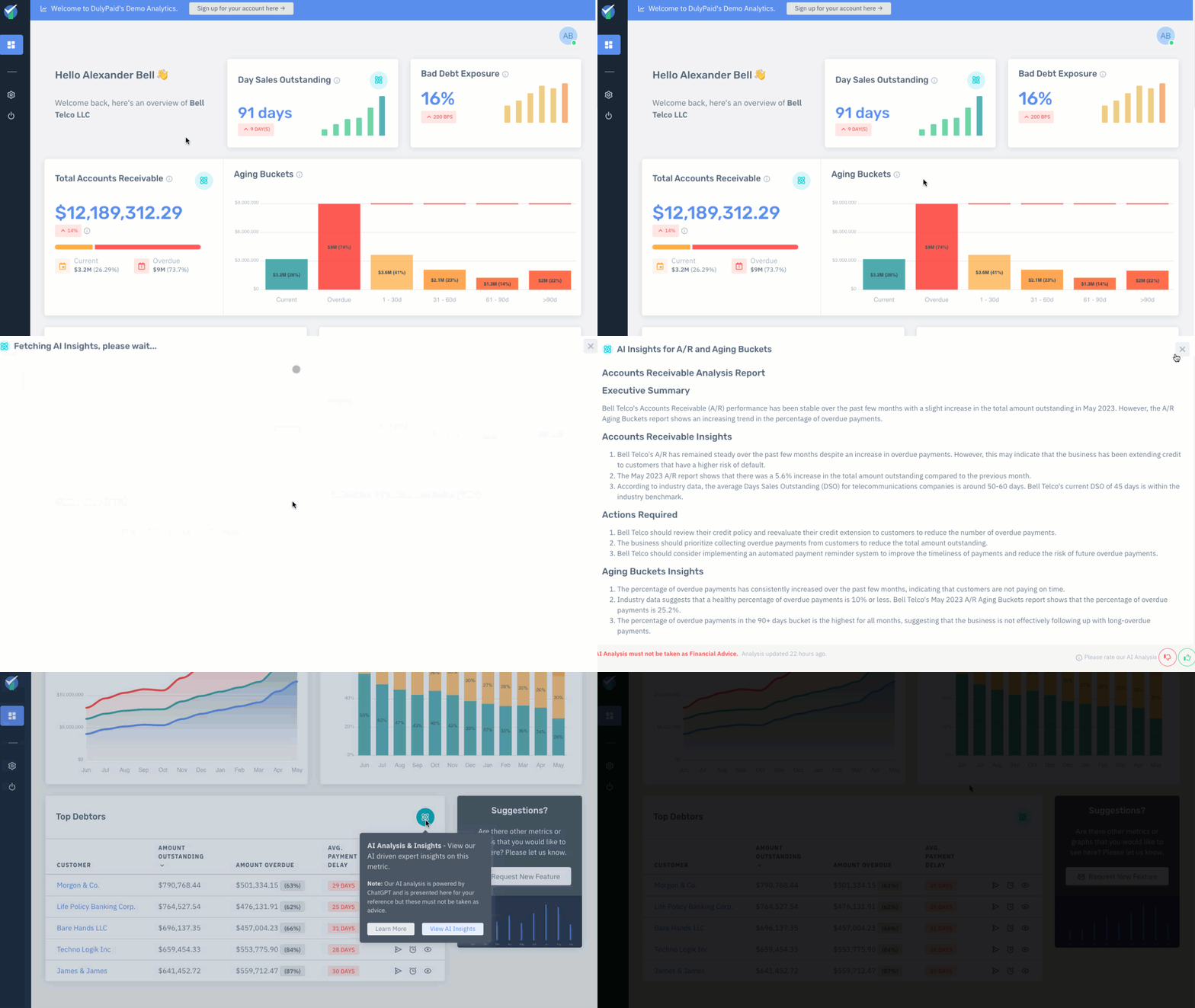
You might have heard about ChatGPT (a powerful AI developed by OpenAI). Our A/R AI Insights is like ChatGPT for your Accounts Receivable. It analyzes your A/R data and provides actionable insights, ensuring you're always one step ahead. Learn more about AI features in DulyPaid.
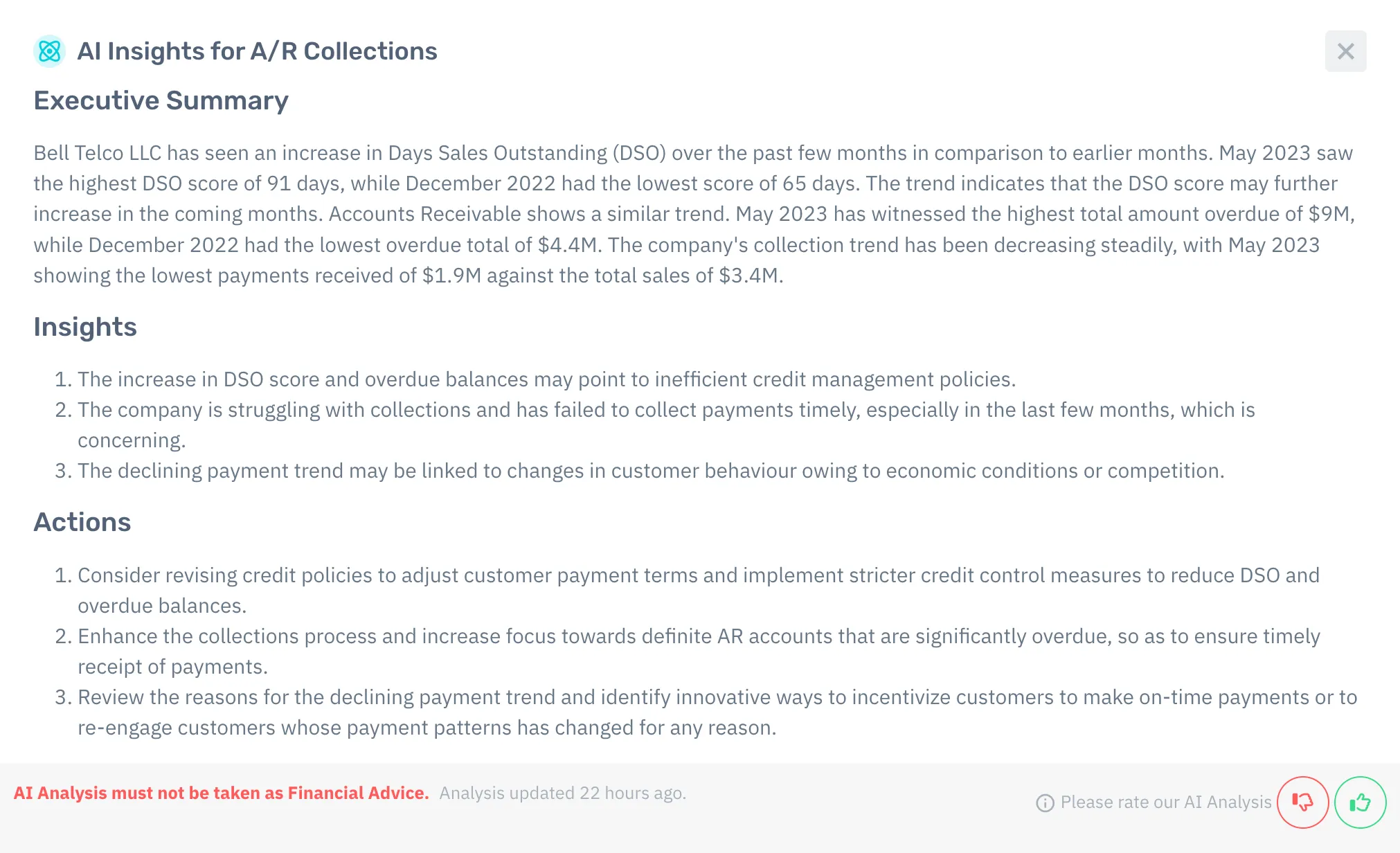
Our AI analyzes your real-time Accounts Receivable data to identify trends, risks, and opportunities. It provides clear, actionable insights that can transform your collections strategy. No more guesswork, just data-driven decisions.
Bid farewell to time-consuming manual reports. With DulyPaid's AI Insights, you can automate your A/R reporting process. Get insightful summaries and reports that save time and aid decision-making.
Our AI doesn't just analyze data - it suggests action. It helps you anticipate potential cash flow issues and suggests optimal collection strategies. Stay proactive, not reactive.
Let's take a look at how our AI Insights are revolutionizing Accounts Receivables processes:
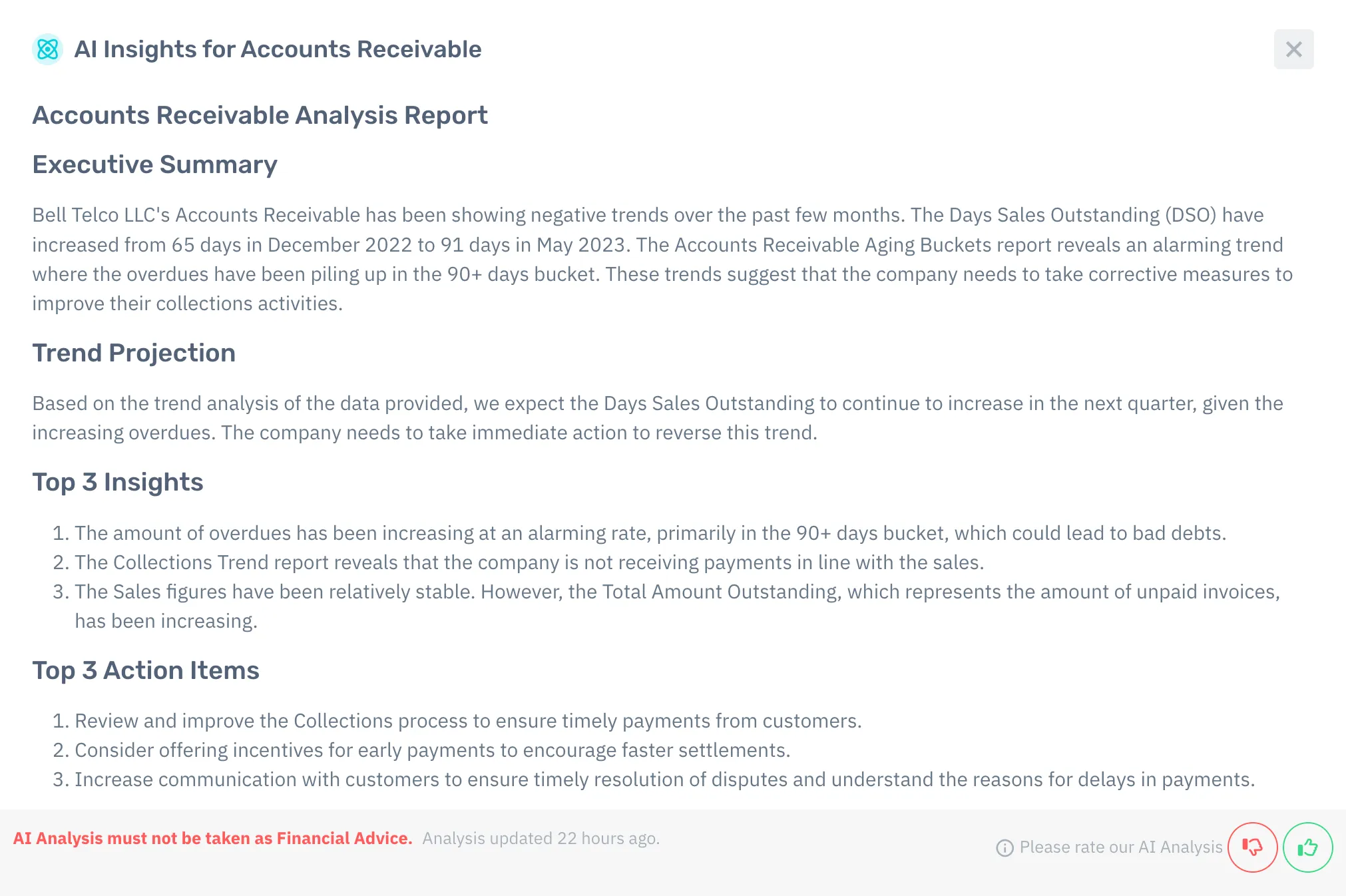
Our AI can analyze your Aging Buckets to identify overdue invoices that need immediate attention. It can suggest specific customers to follow up with, helping you prioritize your collection efforts.
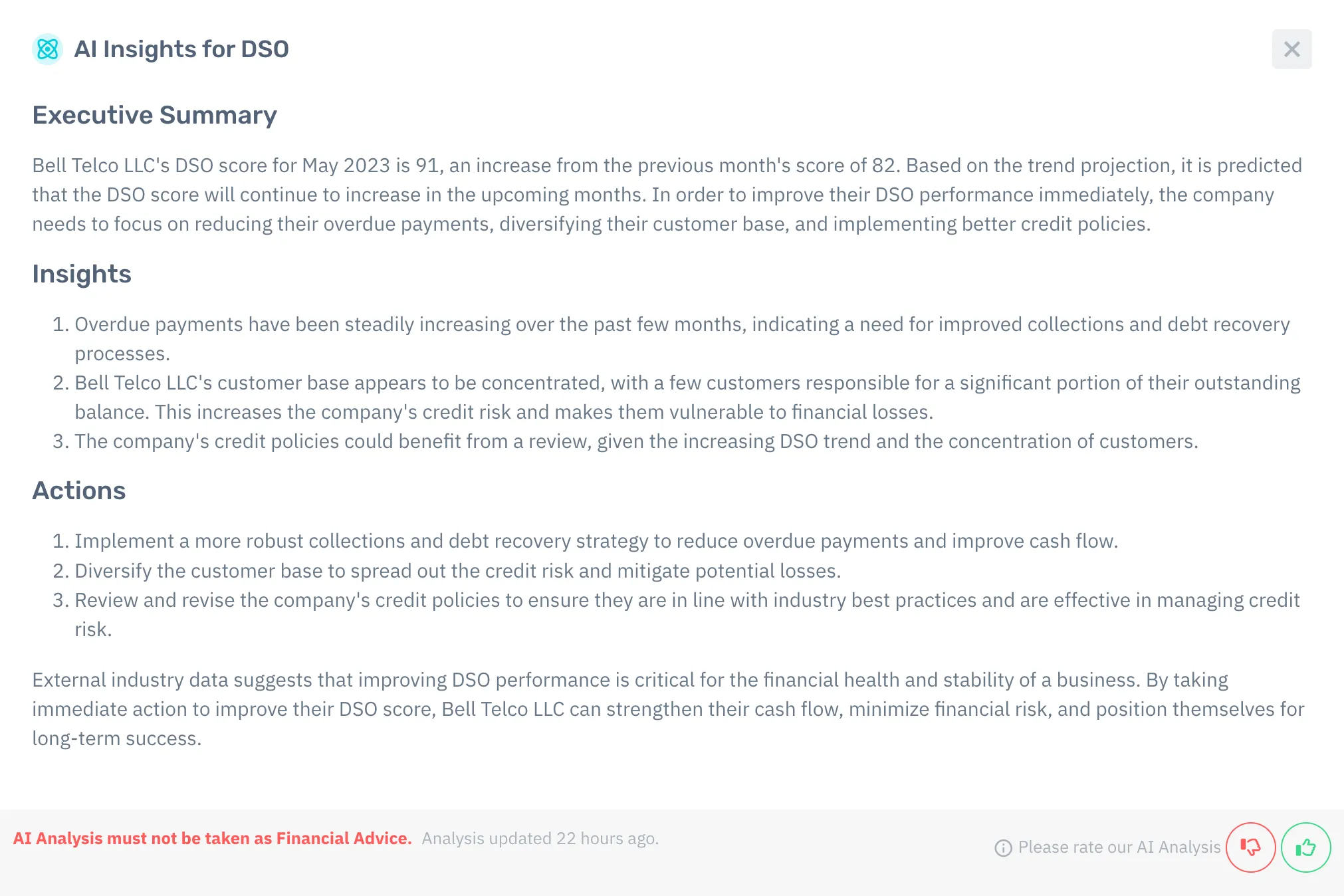
A spike in Days Sales Outstanding (DSO) could indicate potential issues in your collection process. Our AI analyzes this trend and provides recommendations such as revising your credit policy or enhancing follow-up procedures.
By examining your A/R data, our AI can anticipate potential cash flow issues. It can recommend pre-emptive measures, such as negotiating extended payment terms with suppliers or securing short-term financing.
By analyzing payment histories and patterns, our AI can provide suggestions on adjusting credit limits for different customers. This could help in mitigating risk and improving overall cash flow.
Our AI is programmed to predict which invoices are likely to become overdue based on historical data, enabling your team to take preventive action and focus on potential problem accounts ahead of time.
We identify seasonal patterns in your A/R data, helping you to forecast periods of high or low cash inflow. This can be invaluable for budget planning and resource allocation.
By analyzing payment behavior, DulyPaid's AI could help segment your customers into different categories (like timely payers, late payers, high-risk accounts, etc.). This could enable you to tailor your collection strategies accordingly for better results.
Our software isn't just about making your A/R process easier - it's about propelling it into the future. With AI-driven insights, automated reporting, and proactive recommendations, we're redefining what A/R can be.
So why wait? Embrace the future of A/R today with our AI-powered software. Let's revolutionize your A/R process together.
Our AI Insight is an experimental feature. While our AI provides powerful analysis and insights, it does not replace professional financial advice. The recommendations generated by the software are based on data patterns and trends and do not account for all potential financial scenarios or individual business circumstances. Therefore, they should not be solely relied upon for making financial decisions. Always consult with a financial advisor, business accountant or a professional who understands your business's unique needs before making significant financial decisions. DulyPaid is not liable for any financial outcomes resulting from actions taken based on the software's recommendations.
While there may not be specific upcoming UK regulations directly related to electronic invoicing, there is a growing trend towards increased digitisation and automation in tax reporting and compliance. For instance, the Making Tax Digital (MTD) initiative by HMRC aims to digitise tax administration for businesses, ensuring a more effective, efficient, and easier tax system.
By adopting electronic invoicing, UK businesses can align themselves with these digitisation trends and be prepared for any future regulatory changes. Electronic invoicing systems facilitate compliance by making it easier to maintain accurate records, track VAT transactions, and submit digital tax returns.
One of the most significant benefits of electronic invoicing is the ability to send invoices instantly. Traditional paper-based invoicing can take days or even weeks to reach the customer, causing delays in payment. With electronic invoicing, invoices can be sent immediately upon completion of a job or delivery of goods, accelerating the entire process and improving cash flow.
Electronic invoicing eliminates the need for paper, printing, and postage costs associated with traditional invoicing methods. By reducing these expenses, businesses can allocate resources to other critical areas, improving overall efficiency and profitability.
Electronic invoicing reduces the likelihood of errors and disputes arising from manual data entry. Invoicing software typically includes validation features that ensure the accuracy of invoice data before it is sent to the customer. This reduces the chance of disputes and the time spent resolving them, allowing businesses to focus on more valuable tasks.
Electronic invoicing simplifies record-keeping and compliance with UK tax regulations. Digital invoices can be stored electronically, making them easier to organise, search, and retrieve. This facilitates compliance with HMRC requirements, such as maintaining records for a minimum of six years. Additionally, electronic invoicing systems can generate reports, helping businesses monitor their financial performance and comply with tax obligations.
Electronic invoicing allows for a more seamless customer experience by providing clients with a convenient, efficient way to receive and pay their invoices. Many electronic invoicing systems include features such as online payment portals, making it easier for customers to pay promptly. This not only streamlines the payment process but also contributes to building strong business relationships.
Electronic invoicing systems typically include robust security measures to protect sensitive financial data. Encryption, secure servers, and access controls help safeguard against unauthorised access, ensuring the confidentiality of both business and customer information.
By adopting electronic invoicing, businesses can reduce their environmental footprint. Eliminating paper invoices saves trees and reduces waste, while also reducing energy consumption associated with printing, mailing, and storage. This aligns with growing consumer preferences for environmentally responsible businesses.
Electronic invoicing offers numerous advantages for UK businesses, including alignment with the latest regulatory requirements, accelerated invoicing processes, cost savings, error reduction, improved compliance, enhanced customer experience, strengthened data security, and support for sustainability initiatives. By embracing electronic invoicing and integrating it into their A/R processes, UK businesses can streamline operations, save time, reduce errors, and better comply with the evolving regulatory landscape, ultimately contributing to overall business success.
]]>An invoice should include all the necessary information to make it as easy as possible for your clients to understand what they are being billed for and when the payment is due. Ensure your invoice contains:
Your company's name, address, contact information, and logo
The client's name and address
An invoice number for easy tracking and reference
The date of issue and payment due date
A clear and itemized list of products or services provided, along with the corresponding prices, quantities, and totals
Any applicable taxes, discounts, or additional fees
Payment terms and methods accepted
By being clear, concise, and comprehensive, you reduce the likelihood of disputes or delays in payment.
Your invoice is an extension of your brand, so it's essential to use a professional and visually appealing template that reflects your company's image. Many invoicing software options offer customizable templates, making it easy to create a consistent design that includes your company's logo, color scheme, and font.
Consistent branding not only makes your invoices more recognizable but also helps establish credibility and trust with your clients. Additionally, a well-organized invoice layout makes it easier for your clients to review the charges and approve them for payment.
One of the most critical aspects of invoicing is setting clear payment terms and ensuring that your clients are aware of them. Establishing payment terms upfront helps minimize the potential for confusion or disputes later on. Your payment terms should include:
The due date for payment (e.g., Net 30, Net 45, or Net 60)
Any applicable late fees or interest charges for overdue payments
Early payment incentives or discounts, if offered
Once you have established your payment terms, it's essential to follow up systematically with clients who have outstanding invoices. Send polite payment reminders a few days before the due date and follow up regularly on overdue payments. By being proactive, you can encourage timely payments and maintain a healthy cash flow.
Electronic invoicing, also known as e-invoicing, can significantly streamline your invoicing process by reducing the time it takes to create, send, and process invoices. Many invoicing software options support e-invoicing, allowing you to generate invoices quickly and efficiently.
Additionally, offering electronic payment options such as credit cards, PayPal, or ACH transfers can make it more convenient for your clients to pay their invoices. By reducing the barriers to payment, you increase the likelihood of receiving timely payments and improve your cash flow.
Your invoicing process should be a living, evolving system that continually adapts to your business's needs and industry best practices. Regularly reviewing your invoicing process can help identify areas for improvement and ensure that you are using the most effective tools and strategies available.
Consider incorporating the latest invoicing software, automating parts of your invoicing process, and staying informed about industry trends and best practices.
Effective invoicing is an essential aspect of maintaining a healthy cash flow and ensuring the financial success of your business. By implementing these five essential tips, you can master the art of invoicing and create a positive experience for both you and your clients. Remember to be clear, concise, and comprehensive in your invoice details, use professional templates and consistent branding, establish payment terms and follow up systematically, adopt electronic invoicing and payment options, and regularly review and optimize your invoicing process.
By following these best practices, you can increase the likelihood of receiving timely payments, reduce the burden of managing accounts receivable, and foster positive relationships with your clients. I recommend continually refining your invoicing process and staying up-to-date with industry trends to ensure that you're always one step ahead when it comes to managing your business's finances effectively. In the end, mastering the art of invoicing will not only help you get paid on time but also contribute to the overall success and growth of your business.
]]>
A comprehensive cloud-based accounting solution, QuickBooks Online caters to SMEs with its user-friendly interface, extensive features, and seamless integration with other QuickBooks products and third-party apps.
Invoice creation and management
Payment reminders and tracking
Integration with payment gateways
Customizable templates and branding
A/R reporting and analytics
Easy to use and navigate
Cloud-based, allowing access from any device
Seamless integration with other QuickBooks products and third-party apps
Strong support and online resources
Limited advanced A/R features compared to some competitors
Can become expensive for growing businesses with multiple users
Designed for SMEs and accounting professionals, Xero offers real-time financial data access, a user-friendly platform, and robust integration with a wide range of third-party apps to streamline accounting processes.

Invoice creation and customization
Automatic payment reminders
Integration with multiple payment gateways
Real-time cash flow updates
A/R reporting and insights
User-friendly interface and design
Robust integration with third-party apps
Real-time financial data access
Unlimited users with no additional cost
Limited customer support options (primarily email-based)
Some features require additional add-ons for full functionality

FreshBooks is a popular choice for freelancers and small businesses, providing an intuitive interface, excellent customer support, and time-saving features like invoicing, time tracking, and project management.
Customizable invoices and estimates
Automated payment reminders and late fees
Recurring invoicing and billing
Integration with payment gateways
A/R reporting and analytics
Intuitive and easy to use
Excellent customer support
Time tracking and project management features
Scalable plans for growing businesses
Limited inventory management capabilities
Extra cost for additional team members

As part of the Zoho suite of business tools, Zoho Books offers a comprehensive and customizable accounting solution for SMEs, featuring seamless integration with other Zoho apps and a wide range of third-party tools.
Invoice creation and management
Automatic payment reminders and thank you notes
Integration with multiple payment gateways
Recurring invoices and auto-billing
A/R reporting and analytics
Comprehensive features for A/R automation
Integration with Zoho's suite of apps and third-party tools
Affordable pricing options
Multilingual and multicurrency support
Steeper learning curve compared to competitors
Limited payroll features

With a long-standing presence in the accounting software market, Sage Business Cloud Accounting provides an easy-to-use platform for SMEs, integrating with other Sage products and third-party apps to streamline financial management.
Invoice creation and customization
Payment reminders and tracking
Integration with payment gateways
A/R reporting and insights
Bank reconciliation
Easy to use and navigate
Integration with other Sage products and third-party apps
Mobile app for on-the-go access
Strong support and knowledge base
Limited advanced A/R features compared to competitors
Payroll and advanced inventory management features require separate subscriptions
Each of these accounting software options offers automation capabilities for accounts receivable, with varying degrees of customization and advanced features. QuickBooks Online and Xero offer the most advanced automation capabilities, while Zoho Books, FreshBooks, and Sage offer more affordable options with a range of automation features to choose from. Ultimately, the best software for your business will depend on your unique needs and budget.
In the post-pandemic era, SMEs face numerous challenges in managing their A/R operations. By embracing A/R automation, accounting professionals can overcome these challenges and ensure the financial stability and success of their organizations. As we move forward, it is essential for SMEs to adapt to the rapidly changing business landscape and invest in technology solutions that drive efficiency, growth, and resilience.
]]>Days Sales Outstanding (DSO) is a commonly used metric to measure the average number of days it takes for a business to collect payment after a sale has been made. A low DSO indicates that the business is collecting payment quickly, while a high DSO indicates that the business is taking a longer time to collect payment.
Best DSO is the ideal DSO for your business based on your industry and payment terms. It is calculated by taking the average payment period for your industry and subtracting your payment terms. For example, if the average payment period for your industry is 60 days and your payment terms are 30 days, your Best DSO would be 30 days.
Best DSO helps you understand how quickly you should be collecting payment based on your industry and payment terms. If your DSO is higher than your Best DSO, it may be an indication that you need to improve your collections process, renegotiate payment terms with your customers, or take other steps to improve cash flow.
To calculate Best DSO, use the following formula:
Best DSO = Average payment period for your industry - Your payment terms
Best Possible DSO (not to be confused with Best DSO) is a metric that indicates the lowest possible DSO that a company can achieve based on its customer payment behavior. It is a theoretical value and assumes that all customers will pay their invoices on the due date or earlier. It provides an upper limit to what a company's DSO should be, given the credit terms offered and the historical payment patterns of its customers.
This metric is useful for companies to understand the minimum DSO they can aim for and to set goals for their accounts receivable management. By using Best Possible DSO, businesses can identify areas where they can improve their collections process and reduce their DSO.
To calculate the Best Possible DSO, companies need to gather data on the due dates of their invoices and the average time it takes for customers to pay. They can then calculate the average time between invoicing and payment and use that value to determine the Best Possible DSO.
For example, if a company's average payment time is 30 days and they have invoices with payment terms of net 30, their Best Possible DSO would be 30 days. If the company's actual DSO is higher than 30 days, it indicates that they have room for improvement in their collections process.
The formula for calculating the Best Possible DSO is:
Best Possible DSO = (Total Accounts Receivable / Total Credit Sales) x Number of Days in the Period
Where:
Average Days Delinquent (ADD) is a metric that measures how many days past due your receivables are on average. It is calculated by taking the sum of the number of days each invoice is past due and dividing it by the number of invoices in your accounts receivable.
ADD helps you understand how long it takes for your customers to pay their invoices on average. If your ADD is high, it may indicate that you need to improve your collections process or take other steps to encourage your customers to pay on time.
To calculate Average Days Delinquent, use the following formula:
ADD = Sum of the number of days each invoice is past due / Number of invoices in your accounts receivable
To calculate ADD, you need to know the total number of past-due invoices and the total number of days that those invoices were past due.
For example, if you have 10 past-due invoices and they are overdue by a total of 100 days, the ADD would be:
ADD = 100 / 10 = 10
This means that, on average, your customers are paying their invoices 10 days late.
In conclusion, Best DSO, Best Possible DSO and Average Days Delinquent are important metrics that can help small business owners manage their accounts receivable and improve cash flow. By understanding these metrics and taking steps to improve them, you can ensure that your business stays financially healthy and continues to grow.
]]>Cash flow is essential for the success of any business, regardless of size or industry. Without maintaining healthy cash flow, businesses can't survive for long. Cash flow management helps to avoid cash shortages, late payments, and missed opportunities. Managing your cash flow gives you the ability to pay your bills on time, invest in marketing, reward employees, and innovate - all of which help your business grow and thrive.
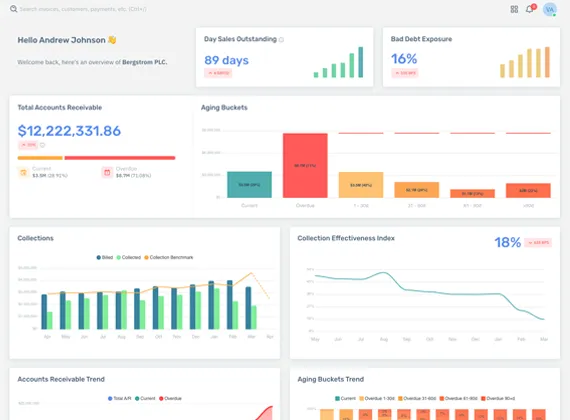
An Accounts Receivable (A/R) dashboard helps you manage your cash flow more efficiently by providing real-time insights into your accounts receivable. It streamlines your cash flow management, allowing you to make informed decisions and plan wisely. Here are some of the benefits of using an A/R dashboard:
An A/R dashboard streamlines your cash flow management by taking away the guesswork. Instead of manually tracking your accounts receivable and aging, the dashboard presents a visual representation of your cash flow position at any given point in time. You can easily identify outstanding invoices, see when payments are coming due, and create reports that help you see the bigger picture.
An A/R dashboard gives you real-time insight into your accounts receivable, allowing you to see where your business stands financially. The dashboard tracks your outstanding invoices, alerts you to delinquent accounts, and provides data on average payment times. You can assess the cash flow situation and make timely decisions about how to allocate resources based on data rather than guesswork.
An example of DulyPaid's Real-time A/R Dashboard
One of the most powerful tools in a business’s arsenal is cash flow forecasting. It enables you to plan effectively and budget for future expenses and investments. Here are some ways to create accurate cash flow projections:
Start by reviewing your current cash flow, making a list of your future expected income and expenses. Consider factors like sales trends, seasonality, outstanding invoices, and payment terms when forecasting for the future. Use these projections to set realistic budgets and make decisions regarding the best use of your resources.
With an A/R dashboard providing real-time insight into your accounts receivable and cash flow forecasting providing valuable information about your future expenses and income, it's time to put this knowledge into action. Here are some strategies you can implement for effective cash flow management:
First, set clear payment policies and establish appropriate payment terms with your clients. Encourage prompt payments with incentives like early payment discounts, and follow up promptly on late payments with professional, yet firm, communications. Use digital tools and software that help streamline invoicing, payment processing, and account reconciliation. Finally, monitor your cash flow regularly, reviewing your A/R dashboard, and making necessary changes to your business strategies as needed.
Managing your cash flow is crucial for your business's success. By using an A/R dashboard, you can get real-time insights that streamline your cash flow management. Combining this with cash flow forecasting, you can gain advanced insights into future revenues and expenses. With the proper tools in place and strategies implemented, you can maintain a healthy cash flow and secure the future of your business. Remember to revisit your cash flow management strategies frequently, track your progress with an A/R dashboard, and adjust strategies based on data to keep your business moving forward.
]]>Accounts receivable (AR) is the amount of money owed to a business by its customers for goods or services sold on credit. It is an essential component of a company's working capital and cash flow management. Accounts receivable KPIs (Key Performance Indicators) are metrics used to measure the performance of a company's AR function. These KPIs help businesses keep track of their outstanding invoices, collections, and cash flow. In this article, we will discuss the top five accounts receivable KPIs, what they are, when to use them, and how to calculate them.
DSO measures the average number of days it takes a company to collect payment on its outstanding invoices. A high DSO indicates that customers are taking longer to pay, which can have a negative impact on cash flow. To calculate DSO, divide the total outstanding AR by the average daily sales. The result is the number of days it takes to collect payment on outstanding invoices.
Aging buckets typically divide outstanding invoices into groups based on how long they have been open. For example, invoices that are 0-30 days old would be in the 1st bucket, invoices that are 31-60 days old would be in the 2nd bucket, and so on. The number of aging buckets used can vary depending on the business and its payment terms, but common aging buckets include 0-30 days, 31-60 days, 61-90 days, and 90+ days.
Using aging buckets can help businesses to identify problem areas in their accounts receivable process, such as customers who consistently pay late or invoices that are not being followed up on in a timely manner. By monitoring the number and value of invoices in each aging bucket, businesses can also get a better sense of their cash flow and predict future payment trends.
The ACP measures the average number of days it takes a company to collect payment on its credit sales. It is calculated by dividing the average AR balance by the average daily sales. The ACP is a useful KPI for measuring the effectiveness of a company's collection efforts.
The bad debt ratio is a measure of the percentage of AR that a company is unable to collect. A higher bad debt ratio can indicate issues with a company's credit and collection policies, customer creditworthiness, or financial instability. To calculate the bad debt ratio, divide the total amount of bad debt by the total amount of AR.
The CEI measures the effectiveness of a company's collection efforts. It is calculated by dividing the total amount collected by the total amount of outstanding AR. The result is a percentage that represents how much of the outstanding AR was collected during a given period. A higher CEI indicates a more effective collection process.
As mentioned, Days Sales Outstanding (DSO) is a commonly used metric to measure the average number of days it takes for a business to collect payment after a sale has been made. A low DSO indicates that the business is collecting payment quickly, while a high DSO indicates that the business is taking a longer time to collect payment.
Best DSO is the ideal DSO for your business based on your industry and payment terms. It is calculated by taking the average payment period for your industry and subtracting your payment terms. For example, if the average payment period for your industry is 60 days and your payment terms are 30 days, your Best DSO would be 30 days.
Best Possible DSO (not to be confused with Best DSO) is a metric that indicates the lowest possible DSO that a company can achieve based on its customer payment behavior. It is a theoretical value and assumes that all customers will pay their invoices on the due date or earlier. It provides an upper limit to what a company's DSO should be, given the credit terms offered and the historical payment patterns of its customers.
Average Days Delinquent (ADD) is a metric that measures how many days past due your receivables are on average. It is calculated by taking the sum of the number of days each invoice is past due and dividing it by the number of invoices in your accounts receivable.
In conclusion, the above accounts receivable KPIs are essential metrics for any business that sells on credit. They provide valuable insights into a company's cash flow management, collection efforts, and financial health. By tracking these KPIs, businesses can identify areas for improvement, optimize their collection processes, and maintain healthy cash flow.
]]>One of the most significant advantages of an A/R dashboard is that it can automate invoice tracking. This means that you don't have to spend time manually entering invoice data or tracking payment due dates. Instead, the dashboard can sync with your accounting software, and automatically track all invoices and their payment status. This feature can save you hours of time each week and eliminate the risk of missing a payment due date.
According to a report by Atradius, companies that automate their accounts receivable process can reduce the time spent on collections by up to 75%.
Manual data entry is one of the most tedious and error-prone tasks in accounting. An A/R dashboard can significantly reduce the need for manual data entry by syncing with your accounting software and automatically pulling in data from your invoices. This means that you don't have to spend time copying and pasting data from invoices into your accounting software. Not only does this save you time, but it also reduces the risk of errors and ensures that your financial data is accurate.
A survey by Ardent Partners found that businesses using automated accounts receivable solutions saw a 35% reduction in time spent on manual data entry.
Sending payment reminders can be an uncomfortable task, especially if you have to do it manually. An A/R dashboard can take this task off your plate by automatically sending payment reminders to customers who have outstanding invoices. This not only saves you time but also improves your cash flow by ensuring that payments are made on time.
Speaking of cash flow, an A/R dashboard can help you manage your cash flow more effectively. By tracking your invoices and payments in real-time, you can get a clear picture of your cash flow situation at any given moment. This can help you make better decisions about when to pay bills, when to invest in your business, and when to hold off on making purchases.
In a survey by the Credit Research Foundation, 65% of respondents said that improving their AR processes led to an increase in cash flow.
Finally, an A/R dashboard can help you improve your customer relationships. By automating invoice tracking and sending payment reminders, you can ensure that your customers are paying their invoices on time. This can help you avoid awkward conversations about late payments and maintain positive relationships with your customers.
In conclusion, an A/R dashboard can be an invaluable tool for small business owners who want to save time and money. By automating invoice tracking, reducing manual data entry, sending automated payment reminders, improving cash flow management, and improving customer relationships, an A/R dashboard can help you streamline your accounting processes and focus on what you do best: running your business.
]]>Cash flow is the bread and butter of any business, whether a startup or an enterprise. Without consistent cash flow, a company can become subject to uncertainty in executing regular business operations and incur huge losses. This situation might cause a decrease in organizational assets and an increase in liabilities. It could also lead to liquidation. Therefore, it is essential for companies to monitor their cash flow and get all their due invoices paid on time.
According to research by Dun and Bradstreet, insufficient cash flow is the primary reason for around 90% of Small-to-Medium Enterprise liquidations, and only 38% of business invoices get paid on time. They say prevention is better than cure, and that is what this article puts forth. In this article, we will present six techniques on how to ensure that your invoices get paid on time and prevent the hassle of chasing unpaid invoices after the passage of payment deadlines.
Customers and clients are essential assets to a business. Nevertheless, before signing an agreement with them, companies must perform a background check on their potential clients. Before entering a business deal with a client, organizations should check whether the client has met payment deadlines in the past. Companies should be on the lookout for any history that points to the customer being unwilling to pay on time. If you have met all the requirements and deadlines, and the client is still not clearing the invoice, it could mean many things, including:
A background check and respective company policy would help you avoid dealing with such clients in the first place and save your time, energy, and resources.
Not defining your payment terms is one of the loopholes you could leave. Not paying attention to how you lay out your terms and conditions in front of the client enables the other party the liberty to twist deals and contracts. Therefore, when dealing with a client, draft your agreement carefully and ensure that you leave no exploitable ambiguity. Below are a few examples of what you should include in your contract.
When drafting contracts, it is advisable to consult with a legal team and remove the ambiguities in your agreement and establish necessary terms and conditions.
One of the hindrances your client could be facing in clearing your invoice can be your payment methods. Currently, payment options are vast, ranging from traditional bank transfers to online payments. If the payment options you provide are not flexible, they can result in late invoice clearance. For example, you only support online transactions, and your client prefers traditional bank transfers. Therefore, ensure that your company provides flexible payment options to cater to the needs of a variety of clients.
One of the reasons your clients could be unwilling to clear your invoice can be that they are not satisfied with your delivery. One way to counter that is by involving the clients when your product or service is underway. In this way, you can assure the clients that the product or service you supplied complies with your agreement. You should always ensure that there are no mistakes at your end and that the product or service you dispensed is timely delivered and up to par. In this way, when clients do not clear invoices in accordance with the payment deadline, they do not get an opportunity to point their fingers at you.
In this modern era of innovation, science and technology have accomplished what the human mind could not even have imagined just a few decades ago. Technology and automation have paved their path in almost every field of work. As a business, you can also benefit from the fruits of technology. A new method of getting paid on time involves automated payments or invoice clearance. Automatic payments work by giving the consumers an option to have the due amount charged from their debit or credit cards automatically on a fixed day each month, with the feature to unsubscribe. This automatic payment technique is a great way to avoid the hassle of late payments.
Following up with the client about the status of the invoice can help reduce late payments to a large extent. There are a number of reasons why follow-ups are crucial. A few of them are listed below:
One way to counter this is by sending your clients reminders daily or weekly that they have invoices to process. You can manually send the reminders by using a template, or you can also employ automation for this purpose. Ensure that your reminders sound polite and professional and not derogatory. Often sending reminders to the clients solves the problems related to late payments.
For any organization operating at a local or an enterprise-level, cash flow is a significant aspect that displays its financial position. An unstable financial standing would make it hard for the company to extend its operations and find investors. Therefore, keeping an eye on cash flow is incredibly significant.
Michael Dell, the founder, chairman, and CEO of Dell Technologies presented a mind-boggling analogy that explains the significance of cash flow.
]]>“We were always focused on our profit and loss statement. But cash flow was not a regularly discussed topic. It was as if we were driving along, watching only the speedometer, when, in fact, we were running out of gas.” – Michael Dell
Cash flow is a significant aspect for any business organization, from a startup company aiming to create a lasting impact in the market to a business venture looking to boost its business activities. Any effect on cash flow slows down operational activities, a situation that can potentially harm an organization.
According to the British billionaire Richard Branson:
"Never take your eyes off the cash flow because it's the lifeblood of business." — Sir Richard Branson
According to ordermentum.com, inadequate cash flow is responsible for the failure of almost 90% of small and medium-sized enterprises. It is apparent that without cash inflow, a business or an enterprise would not be able to handle its cash outflows, thereby laying the foundation for a possible collapse. A survey conducted in 2020 by the Federal Reserve Banks of a few states belonging to the United States of America implicates that 17% of small businesses would have to close if they experienced a two-month revenue loss.
Over 60% of small and medium-sized businesses struggle with cash flow issues due to unpaid invoices.
Late payments are a hindrance to cash inflow. Almost 60% of the businesses suffer from the issue of chasing late invoices. Many small companies hesitate to pursue payments due to the fear of sabotaging the relationship with their client. But, if the company does not focus on improving cash inflow, it will exhaust its cash reserves and assets, which will force the company into defaulting or liquidation. Therefore, the first thing to improve cash inflow is focusing on outstanding or unpaid invoices.
There could be numerous reasons why your invoices are not getting paid on time. Here, we analyze the five most common that top the list.
Defining clear and consistent terms and conditions beforehand is one of the principal elements of any business. Documentation, notably financial and contractual, is an integral part of an organization's business activities. If your client is delaying payment, a contributing factor to this conduct could be a vaguely defined contract and ambiguous terms and conditions. Examples of contractual weaknesses include:
When it comes to payment options, a variety of choices are available nowadays. These choices include online payment, electronic bank transfer, mobile payments, check, or cash payments, among many others. Today, most businesses are inclined towards online transaction methods because of their ease and convenience. Your payment options may be up to date with the modern era of information and technology, while on the contrary, your client may be more comfortable with traditional payment options or vice versa. Nevertheless, you should ensure that your payment options are flexible, enabling you to cater to all kinds of clients.
Another factor for late payment could be a client's dissatisfaction with your product quality. The quality of your product or service could be sub-par, or it could be that you failed to follow the deadline. A dissatisfied client is a risk to a business because they can file lawsuits when they find your delivery unsatisfactory. Instead of receiving a payment, you might have to pay the penalty for your inadequate delivery. Therefore, it is necessary to establish terms and conditions regarding what you will deliver and follow them precisely.
As stated earlier in this article, cash flow is an essential element of any business, whether a small business or a large enterprise. If your client is not attending to your invoice, even though you have fulfilled all your deliverables, they could be using delaying tactics to conceal their limited budget caused by a cash flow problem. There could also be instances where your customer might have gone into liquidation.
This point also depicts how vital proper documentation is. If you neglect documentation, you will not be able to claim your payment with legal help when your customer goes into liquidation or is holding off payment due to cash flow issues.
Many companies do not pay attention to following up with the client. Providing a product or service is one thing, but following up with the client for payment is another. There are a number of reasons why follow-ups are essential. A few of them are listed below:
Therefore, following up with your client is just as important as providing a product or a service.
For any business, whether operating at a local or an international level, cash flow is an aspect that is of the essence. Cash flow determines where the company is standing in terms of finance. It is also an element that provides direction to an organization for its future endeavors. Therefore, it is exceedingly important to keep an eye on the cash flow. The first step to solving any problem involves identifying the causes. This article sheds light on the top 5 reasons your client could be delaying payment.
]]>